Per job, by reducing manual sorting, follow-up cleanup, and repeated re-entry.
Built for field-service operations
TradeFlow turns rough job information into stored, verified, usable work.
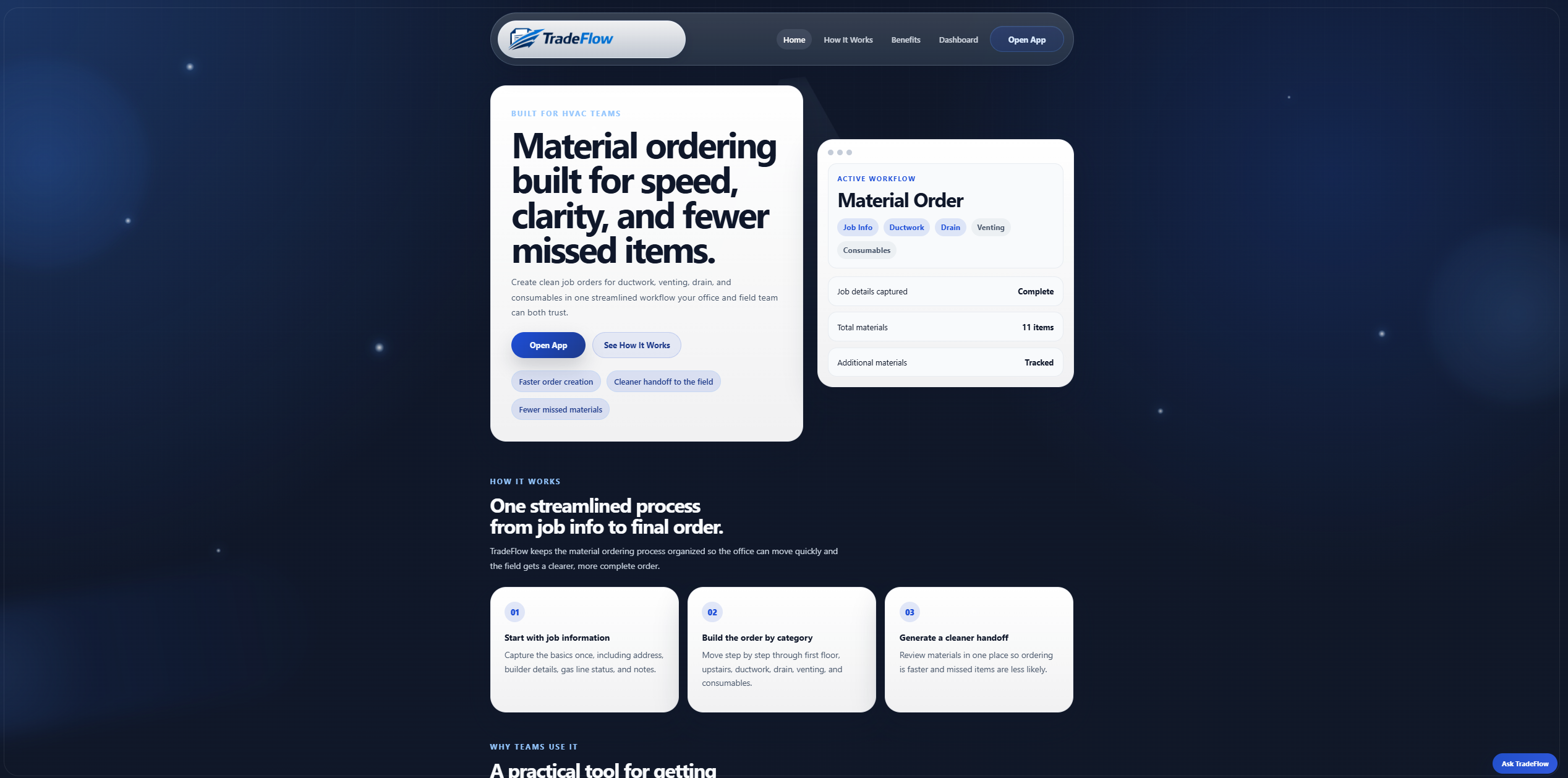
This demo shows how TradeFlow helps an HVAC business move faster with less confusion: cleaner job intake, smarter material handling, clearer pricing, built-in verification, and saved records that can be found later.
- Creates structured jobs from messy notes
- Stores records for later review and reuse
- Verifies output before it is trusted
- Supports service, rough-in, and quoting flows
Business impact
What this improves in day-to-day operations
Verification and rule-based carryover catch gaps before orders go out.
Materials are organized into usable categories instead of living in raw field shorthand.
Past work can be found again by address, builder, estimator, date, and status.
Live system snapshot
What TradeFlow does after the user starts entering work
The goal is not just to create a file. The goal is to organize the job, carry repetitive logic automatically, check the output, save the result, and make the work easy to retrieve later.
Active records currently stored in the demo dashboard.
Post-generation review result for the current output.
Estimated reduction vs manually sorting, pricing, and reviewing.
Uses explicit pricing logic instead of hidden spreadsheet math.
Interactive demo
Simulate the system behavior
Current job record
What the system remembers
Business value
Why it matters to a real trade business
Less re-entry
One job record carries the address, builder, estimator, selected materials, and output history so the office does not have to rebuild the same context over and over.
Fewer missed items
Rule-based carryover, AI-assisted parsing, and verification reduce the chance that important materials disappear between field notes and final ordering.
Faster handoff
Structured material outputs and supplier-facing summaries can be reviewed and sent much faster than manually cleaning up shorthand notes.
Explainable pricing
Pricing can be explained clearly because the system uses visible rules, category handling, and consistent breakdowns instead of hidden math.
Next step
Open the walkthrough to see the workflow step by step.
This is where the demo moves from high-level value into actual product behavior.